

Il nostro obiettivo
Viaggiare sani e sicuri – la nostra principale preoccupazione è che tu possa goderti il tuo viaggio in buona salute e che diventi un’esperienza indimenticabile! Siamo al tuo fianco, con informazioni per una preparazione ottimale del viaggio, raccomandazioni di vaccinazione, mappe, consigli in caso di malattia e molto altro! Tutte le informazioni possono essere compilate e salvate individualmente. Il sito è in costruzione e sarà continuamente aggiornato con nuovi contenuti e aggiornamenti.
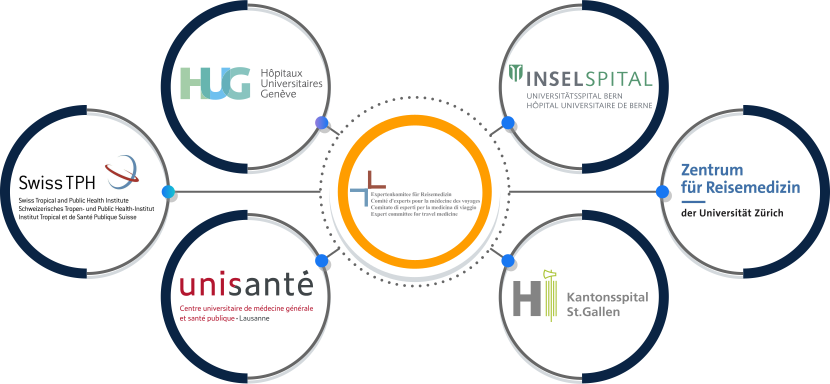
Nostri Esperti
Ultime notizie
Informati sulle ultime notizie di medicina di viaggio per la tua destinazione
Worldwide: Chikungunya risk - countries with outbreaks or elevated risk - update 07 October 2026
The Swiss Expert Committee for Travel Medicine has updated the list of countries with chikungunya transmission risk primarily based on CDC country list and – if available – on epidemiological news (red = changes since the previous update of 10 September 2026).
! Please note: Classifying countries as having an outbreak or an elevated risk is challenging, as definitions vary between sources and data are often lacking or delayed.
Bundibugyo-Ebola-Ausbruch in der DR Kongo: WHO-Risikobewertung vom 6.Oktober 2026
Der Ausbruch der Bundibugyo-Viruskrankheit (BVD) betrifft 64 Gesundheitszonen in sieben Provinzen. Insgesamt wurden 8’665 bestätigte Fälle und eine hohe Fallsterblichkeitsrate von 48 % gemeldet. Die Provinz Ituri ist mit 6'450 Fällen (2'968 Todesfällen) weiterhin am stärksten betroffen.
Die Demokratische Republik Kongo verstärkt mit Unterstützung der WHO und ihrer Partner die Massnahmen zur Eindämmung des Ausbruchs. Auch die Vorsorgemassnahmen in den Nachbarländern laufen weiter. Die WHO betont weiterhin die Bedeutung einer verstärkten Überwachung, einer verbesserten Vorbereitung und grenzüberschreitender Kontrollmassnahmen, um eine weitere Ausbreitung zu verhindern.
Importierte Fälle im Zusammenhang mit dem Ausbruch in der Demokratischen Republik Kongo:
- Kenia: Am 6. Oktober wurde der erste importierte Fall einer Bundibugyo-Viruskrankheit gemeldet.
- Niederlande: Ein in der Demokratischen Republik Kongo tätiger Mitarbeiter von Ärzte ohne Grenzen (MSF), bei dem am 29. September eine Infektion mit dem Bundibugyo-Virus bestätigt wurde, wurde zur Behandlung in die Niederlande evakuiert
Datenstand: 6. Oktober 2026, aktuelle Informationen finden Sie im WHO-Dashboard und beim ECDC.
Senegal: Diphtheria outbreak - update
Uganda: Yellow fever vaccination entry requirement
A Yellow Fever Vaccination certificate is no longer a mandatory requirement for entry into Uganda. This requirement is not listed on the e-visa application portal (www.visas.immigration.go.ug) or on the National Citizenship and Immigration Control (NCIC) website (www.immigration.go.ug).
However, vaccination against yellow fever remains strongly recommended for personal protection, as yellow fever is endemic in the country.
USA: Ongoing mumps outbreak at San Diego State University - update
As of 30 September 2026, 14 confirmed and one probable mumps case had been reported at San Diego State University, up from five confirmed or probable cases on 18 September. The outbreak remained confined to a single football team and one associated case, disrupting the team’s activities for three consecutive weeks.
Nationwide, 157 mumps cases had been reported across 31 US jurisdictions as of 10 September 2026, including 25cases in California.
USA: Increase in measles cases in New York and Pennsylvania
As of 3 October 2026, New York State had reported 108 confirmed measles cases across 18 counties, including seven in New York City. Most cases (92) occurred since mid-July, primarily in under-immunized rural communities. On 5 October, the governor declared a state disaster emergency to expand access to vaccination and testing.
Neighboring Pennsylvania reported more than 1’000 cases as of 5 October and five measles-associated deaths. The outbreak is centered in Lancaster County and has spread to 39 counties, including four bordering New York, raising concerns about further cross-border transmission.
Côte d’Ivoire: Gelbfieberausbruch
In Côte d’Ivoire wurden in den ersten 34 Wochen des Jahres 14 bestätigte Gelbfieberfälle und zwei Todesfälle gemeldet. Die Fälle traten in acht Gesundheitsbezirken auf: Doropo, Téhini, Agboville, Bouna, Danané, Jacqueville, San Pedro und Toulepleu.
Besonders häufig erkrankten ältere Kinder, Jugendliche und Erwachsene zwischen 15 und 39 Jahren. In den Wochen 32–34 wurden wieder mehr Fälle festgestellt.
Die Impfquote gegen Gelbfieber ist in einigen Regionen zu niedrig. Mehrere betroffene Gebiete liegen zudem an den Grenzen zu Burkina Faso, Ghana, Liberia und Guinea. Die zusammenhängenden Waldgebiete und die hohe Mobilität der Bevölkerung, unter anderem durch den handwerklichen Goldabbau, könnten eine grenzüberschreitende Ausbreitung begünstigen.
Auch in Ghana wurden bestätigte Gelbfieberfälle gemeldet, sodass eine grenzüberschreitende Ausbreitung möglich ist.
Costa Rica: Increase in locally acquired chikungunya cases in San José province
On 17 September 2026, Costa Rica’s Ministry of Health reported a chikungunya outbreak in the densely populated urban Pavas District, San José Province, with 12 confirmed and three probable cases. No deaths have been reported. The outbreak was linked to travellers returning from Nicaragua, with subsequent local transmission confirmed in five sectors of Pavas.
A concurrent chikungunya outbreak in Playa Langosta, Guanacaste Province, remains active; year-to-date 2026, Costa Rica has reported 367 total chikungunya cases nationally.
Vietnam: Food poisoning outbreak linked to banh mi sandwiches

Trova specialisti
Siamo qui per voi! Qui puoi trovare specialisti nella tua zona che hanno esperienza in viaggi e medicina tropicale. Prendi un appuntamento!
Leggi piùPrima del viaggio
HealthyTravel Pro
HealthyTravel Pro per consigli e consulenze mediche sui viaggi
- Contenuti scritti dal Comitato svizzero di esperti in medicina di viaggio
- Consigliato ai professionisti della salute
- Aggiornato regolarmente
- Accesso alle SOP
- Mappe dettagliate