

Our Purpose
Healthy and safe travel - our main aim is that you can enjoy your trip in good health and that it becomes an unforgettable experience! We are at your assistance, whether with information for optimal travel preparation, vaccination recommendations, maps, tips in case of illness and much more! All information can be compiled and saved individually. The site is under construction and will be continuously expanded with additional content and updates.
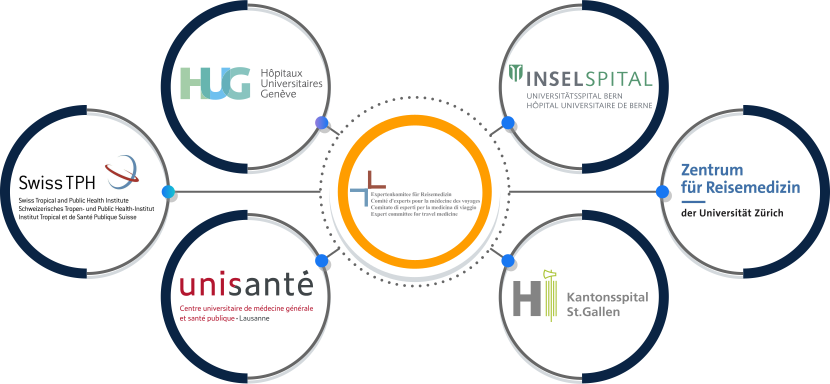
Our Experts
Latest News
Get informed about the latest travel medicine news in your destination
Public Health Emergency of International Concern: Ebola disease outbreak caused by Bundibugyo virus in D.R. Congo, Uganda – update 28 May 2026
On 15 May 2026, the DRC declared a Bundibugyo Ebola outbreak, while Uganda reported two imported cases. WHO declared a Public Health Emergency of International Concern (PHEIC) on 16 May, see EpiNews 21.5 2026.
As of 26 May 2026:
D.R. Congo:
- Cases: More than 1’100 cases (>1000 suspected, >120 confirmed cases). Confirmed cases have been reported from Ituri (110 confirmed cases), North Kivu (11 confirmed cases) and South Kivu provinces (one confirmed death).
- Deaths: 246 suspected and 17 confirmed deaths. Of the confirmed deaths, 14 deaths were individuals over 15 years of age, while three were under 15.
- Location: Cases have been reported in three provinces: Ituri (16 health zones), North Kivu (2 health zones), and South Kivu (1 health zone).
- Contacts: As of 25 May, more than 2’231 contacts have been identified, with approximately 20% under follow-up. The laboratory test positivity rate in DRC is currently 30.0%.
- Operational update: Bunia airport, DRC, has been temporarily closed.
- Operational challenges:
- Information regarding transmission chains and affected population groups is currently limited, partly due to the complex context of ongoing insecurity and humanitarian challenges in the affected areas.
- Several sources have reported local protests and arson attacks targeting treatment centres with escape of at least 25 suspected cases. Citizens burned two tents in a hospital section treating Ebola patients. Volunteers have also faced intimidation and threats from armed groups in Bunia.
- Information regarding transmission chains and affected population groups is currently limited, partly due to the complex context of ongoing insecurity and humanitarian challenges in the affected areas.
WHO expects those numbers to keep increasing, given the amount of time the virus was circulating before the outbreak was detected.
Uganda:
- Cases, deaths: a total of seven confirmed cases, including one death have been reported. Three of the cases have travel links to DRC and five are contacts linked to the first two cases, including 3 healthcare workers.
- Location: Cases have been diagnosed and are hospitalized in Kampala.
- Contacts: As of 24 May, 311 contacts linked to the confirmed cases have been identified and are being closely monitored and followed up.
Further cases:
- One confirmed BVD case involving a US surgeon who had worked in the affected area in DRC was transferred to Germany and is hospitalised in Berlin alongside six high-risk contacts. One additional contact was transferred to the Czech Republic.
- On 27 May, an asymptomatic Italian doctor returning from Ituri (DRC) after exposure to confirmed cases was placed in quarantine in Rome.
- South Sudan is investigating a suspected Bundibugyo virus disease case in West Equatoria State after a preliminary positive result in a patient from South Yambio County.
Exit screening and control measures:
- Regional: Exit screening and health control measures have been implemented for travellers from DRC, Uganda, and South Sudan.
- Uganda has ceased air travel to DRC, closed multiple border crossings, and increased border crossing screenings (LINK).
- Rwanda: Reinforced health screening at land border crossings with DRC and enhanced entry screening at Kigali International Airport for inbound travellers to Rwanda.
- United States: Introduced enhanced entry screening measures and established a regional Ebola quarantine and treatment facility in Kenya for exposed or infected US citizens.
- Canada: Temporary entry restrictions for residents of DRC, Uganda, and South Sudan effective from 27 May for 90 days. From 30 May, asymptomatic Canadian citizens and residents returning from high-risk areas will be subject to a 21-day quarantine.
- For other countries, see IATA LINK which will be constantly updated.
Public Health Emergency of International Concern declared for Ebola disease outbreak caused by Bundibugyo virus in D.R. Congo and Uganda
On 5 May 2026, WHO was alerted of a cluster of unknown febrile illnesses with a high mortality rate in Mongbwalu and Rwampara Health Zones, Ituri Province. Following investigation by rapid response teams, the cause was confirmed to be Bundibugyo virus disease (BVD) due to Bundibugyo virus (Orthoebolavirus bundibugyoense) - a species of Ebola virus - on 15 May with 8/13 positive samples from Rwampara.
On 15 May 2026, the DRC declared its 17th Ebola outbreak, affecting Rwampara, Mongbwalu, and Bunia Health Zones. Uganda subsequently confirmed two imported cases. On 16 May 2026, WHO declared the outbreak a Public Health Emergency of International Concern (PHEIC).
As of 20 May 2026 (WHO press releaset):
- More than 600 suspected cases (>500 in DRC, 12 in Uganda) and 139 suspected deaths (131 in DRC, 1 in Uganda. Most suspected cases were reported in Mongbwalu (302 cases, 74 deaths) and Rwampara (136 cases, 74 deaths), Ituri Province.
- 35 confirmed cases (33 in DRC, 2 in Uganda), including 5 deaths (4 in DRC, 1 in Uganda), corresponding to a CFR of 14.3% (5/35). In DRC, confirmed cases were reported in four health zones in Ituri Province — Rwampara (19), Bunia (6), Nyankunde (4), and Mongbwalu (1) — and three health zones in North Kivu: Butembo (1), Goma (1), and Katwa (1).
WHO expects those numbers to keep increasing, given the amount of time the virus was circulating before the outbreak was detected.
Further cases:
- The US citizen who has tested positive has been transferred to Germany (with six high risk contacts). One other contact will be transferred to Czechia.
- South Sudan is investigating a suspected Bundibugyo virus disease case in West Equatoria State after a preliminary positive result in a patient from South Yambio County.
- Information regarding transmission chains and affected population groups is currently limited, partly due to the complex context of ongoing insecurity and humanitarian challenges in the affected areas.
- Genomes from DRC and Uganda have been published and preliminary analysis shows distinct
sequences from the previous outbreaks (Virological Ebolavirus/Bundibugyo ebolavirus, 18 May 2026).
Authorities are concerned about the risk of further spread due to population high mobility, insecurity, and the proximity of affected areas to Uganda and South Sudan through a porous border.
The D.R. Congo has experienced several Ebola outbreaks in recent years. The most recent outbreak, in the Kasai provinces (species Orthoebolavirus zairense), was declared over in December 2025. In Ituri Province specifically, Ebola disease due to Ebola virus (Orthoebolavirus zairense) was last documented during the 2018-2020 outbreak. Bundibugyo virus was first reported in 2007 in Bundibugyo district in Uganda during an outbreak. The most recent outbreak due to Bundibugyo virus was in 2012 in DRC.
International waters: Hantavirus outbreak among cruise ship passengers - update
A cluster of Andes hantavirus infections linked to the Dutch-flagged cruise ship MV Hondius in the South Atlantic has resulted in multiple cases among passengers and crew from several countries. The outbreak involves Andes virus (ANDV), the only hantavirus known to cause limited person-to-person transmission, typically through close and prolonged contact.
Updates on new reported cases between 8 and 15 May 2026:
New cases - three new cases after the after evacuation from the cruise ship:
- One confirmed case in France – who became symptomatic during repatriation.
- One confirmed case in Spain.
- One of the passengers who was evacuated from the ship had a positive result for hantavirus by PCR on 12 May 2026. The person was asymptomatic at the time of testing but successively developed respiratory symptoms. The individual currently remains in isolation.
- One inconclusive case was reported in the United States involving an asymptomatic passenger repatriated on 10 May, with conflicting laboratory results (one positive and one negative from separate laboratories). A second US citizen reportedly developed mild symptoms during evacuation, although details remain unclear based on currently available information.
Total cases:
- 11 cases (8 confirmed, 2 probable, 1 inconclusive case), including 3 deaths.
Other news:
- The cruise ship MV Hondius arrived at the port of Granadilla, Tenerife on Sunday 10 May.
- Disembarkation of guests and part of the crew was carried out and completed on 11 May. Disembarked guests and crew members were transported to the airport and repatriated via evacuation flights throughout 10 and 11 May.
- Evacuation was carried out from Tenerife to the following countries: Spain (14), France (5), Canada (4), the Netherlands (26), UK (22), Ireland (2), Turkey (3), US (17).
- The ship departed Tenerife on 11 May and is expected to arrive in the Netherlands on 17–18 May.
- Preliminary genome sequencing analysis showed high genetic similarities between isolates of Andes virus, likely indicating an initial zoonotic spillover event followed by human-to-human transmission.
- Investigations into the travel history and potential exposures of the first case in the Southern Cone are ongoing and suggest possible exposure to rodents during bird watching activities.
- For details, see ECDC and WHO reports, or on BEACON.
- For contact management: see WHO LINK.
Additional cases among cruise ship passengers remain possible due to the long incubation period of hantavirus infection, which can last up to 6–8 weeks. However, current response measures — including quarantine of disembarked passengers, rapid isolation of suspected cases, and contact monitoring — are expected to reduce the risk of further transmission.
Botswana: Four children died of rabies
A rabies outbreak in the city Maun, Botswana, has resulted in four child deaths since February 2026, including a recent fatal case in a four-year-old girl bitten by a dog. Authorities report critical shortages of anti-rabies vaccines.
Canada, Mexico, USA: FIFA World Cup 2026
More than five million spectators are expected to attend the 2026 FIFA World Cup, scheduled from 11 June to 19 July 2026 across 16 host cities in Canada, Mexico, and the United States. Matches will be held in Toronto and Vancouver; Guadalajara, Mexico City, and Monterrey; and 11 US cities, including New York City, Los Angeles, Miami, and Seattle.
Global: Hantavirus outbreak on cruise ship in international waters – update
A multi-country cluster of hantavirus disease has been reported aboard a Dutch-flagged cruise ship, the MV Hondius, which departed Ushuaia, Argentina, on 1 April 2026 and travelled across the South Atlantic, with stops including Antarctica, South Georgia, Saint Helena, and Ascension Island. As of 6 May 2026, the vessel is on its way to Canary Islands and carried 146 passengers and crew from 23 nationalities.
CASES:
- Onset: 6 – 1 May 2026
- Dx (lab confirmation in South Africa): 2 May (case 2)
- Symptoms: Fever, GI symptoms, rapid progression to pneumonia, ARDS, and shock.
- Total: 8 cases (5 laboratory-confirmed, 3 suspected)
- Current status: 3 fatalities; 1 critically ill in ICU; 4 with mild-to-moderate symptoms
- 1 confirmed case hospitalized in Zurich (mild)
- 2 confirmed cases hospitalized in Leyden (mild)
- 1 confirmed case hospitalized in Johannesburg (critically ill)
- 2 suspect cases in Düsseldorf and Leyden
- 1 confirmed case hospitalized in Zurich (mild)
KEY DETAILS:
- Two early confirmed cases had travelled in South America before boarding the cruise ship.
- Andes virus infection was confirmed by PCR at the HUG reference laboratory.
- Human-to-human transmission of Andes virus is possible, particularly after close and prolonged contact. The risk appears highest during the first days of symptoms.
- A coordinated international response is ongoing, involving the United Kingdom, the Netherlands, South Africa, Spain, and Cabo Verde.
- Passengers have been advised to maintain physical distancing and remain in cabin isolation.
- Additional cases among cruise ship passengers remain possible, given the long incubation period of hantavirus infection, which can extend up to 6–8 weeks. Monitoring should therefore continue for several weeks.
- WHO press conference, 07.05.2026; youtube
Dominican Republic: Leptospirosis
As of 18 April 2026, the Dominican Republic had confirmed 74 leptospirosis cases among 134 suspected cases, a 50% increase compared with the same period in 2025, with four reported deaths. Cases are spread across several provinces, particularly Espaillat, Santo Domingo, Santiago, Peravia, and Duarte.
Authorities link the rise to persistent rainfall and flooding, which increase exposure to contaminated water. Public health warnings emphasize avoiding stagnant water, improving hygiene, controlling rodents, and seeking prompt care for symptoms such as fever, headache, calf or back pain, vomiting, and jaundice.
Leptospirosis is primarily transmitted through the urine of rodents, especially rats, contaminating water sources such as rivulets, puddles, or mud. Humans can become infected through direct or indirect contact with contaminated urine via small skin cuts or mucous membranes. Clinical manifestations range from flu-like symptoms to aseptic meningitis and sepsis.
Mauritius: Leptospirosis
Mauritius has reported 20 leptospirosis cases since January 2026, with five deaths as of 5 May and two stable active cases under observation. Several severe cases presented late, already with jaundice, suggesting delayed medical consultation. The latest fatality was a 60-year-old gardener from Montagne Blanche with underlying conditions, who arrived at hospital with advanced jaundice and dehydration. Authorities have identified more than 90 rat-breeding sites in Beau Bassin-Rose Hill and Quatre Bornes, highlighting environmental risk from rodent-contaminated soil and water. Nearby Réunion is also experiencing a major rise in leptospirosis cases, but with a lower reported fatality rate than Mauritius.
Leptospirosis is primarily transmitted through the urine of rodents, especially rats, contaminating water sources such as rivulets, puddles, or mud. Humans can become infected through direct or indirect contact with contaminated urine via small skin cuts or mucous membranes. Clinical manifestations range from flu-like symptoms to aseptic meningitis and sepsis.
Australia: Marine toxin poisoning (Ciguatera)
Since late April 2026, several cases of ciguatera poisoning have been reported in Queensland’s Cassowary Coast region after consumption of large reef fish, including coral trout and Spanish mackerel.
Symptoms developed within 24 hours and included gastrointestinal illness, tingling or numbness, cold-induced burning sensations, muscle weakness, and occasionally breathing difficulty.
Health authorities warned people to avoid eating fish over 6 kg, not to consume high-risk parts such as the head, roe, or liver, and to test only a small portion before wider consumption.
Ciguatera Poisoning: Ciguatera is a non-contagious foodborne illness caused by eating fish containing ciguatoxins, usually due to improper preparation. Symptoms appear 3–6 hours after ingestion (up to 30 hours) and typically start with gastrointestinal issues—diarrhea, nausea, vomiting, and abdominal pain—followed by neurological and neuropsychiatric signs such as paresthesia, weakness, burning or metallic taste, memory issues, fatigue, and mood changes. Cold allodynia and temperature reversal are distinctive but not always present. Neurologic symptoms may last days to months, while cardiovascular effects can include bradycardia, heart block, or hypotension.

Ask a specialist
We are at your service! Here you can find specialists in your area who have experience in travel and tropical medicine. Make an appointment!
View moreBefore Travel
HealthyTravel Pro
HealthyTravel Pro for medical travel recommendations and consultations
- Content written by Swiss Expert Committee of Travel Medicine
- Recommended for professionals
- Updated on a weekly base
- Access to SOP
- Detailed maps

Updates of recommendations
Find out about the latest content updates on the websiteSwiss Vaccination Plan - update 2026
The Swiss vaccination plan 2026 has been published by the Swiss Federal Office of Public Health, issuing new recommendations for Switzerland.
Polio vaccination recommendation - South Sudan
The WHO's temporary poliomyelitis vaccination recommendation has changed for South Sudan.
Chikungunya recommendation - update
The US CDC has updated the areas at risk for chikungunya on 22 April 2026.
Yellow Fever Country List
The 'Yellow fever country list (vaccination recommendations and countries’ entry requirements) has been updated and is available on PRO Version -> yellow fever -> documents for professionals.
Polio – updated WHO temporary recommendations
The country pages have been updated to reflect the updated WHO temporary polio recommendations.
Archive
Chikungunya – new recommedation
The Swiss Expert Committee on Travel Medicine has issued a recommendation on the use of chikungunya vaccine for French Guiana.
Malaria risk areas - update
The risk areas and country maps for malaria have been updated.