
Portogallo
Ultime notizie
As of March 2026, mpox transmission continues globally across all clades, with clade Ib now confirmed for the first time in Argentina, Ecuador, Austria, the Central African Republic, Russia and Singapore and community transmission documented in five European countries (Austria, Belgium, Portugal, Spain, and the UK).
Sustained community transmission in Madagascar (clade Ib), Pakistan.
DRC Ministry of Health officially declares the end of the mpox epidemic as a national public health emergency on April 2, 2026.
A recombinant clade Ib/IIb strain has been detected in two travelers, with evidence suggesting wider circulation than currently documented (see WHO).
End of March, EMA’s committee for human medicines has issued a recommendation that Tecovirimat SIGA should not longer be used for the treatment of mpox (see EMA).
See also WHO global trends.
Risk very low for general populations but moderate for at risk groups.
Follow recommendations issued by local health authorities.
- Avoid close, skin-to-skin contact with individuals who have, or may have, mpox, including anyone with a rash (pimples, blisters, scabs).
- Wash hands frequently with soap and water or use an alcohol-based hand sanitizer at least 60% alcohol).
- Avoid touching potentially contaminated personal items such as bedding, clothing, towels, cups, or eating utensils used by someone with suspected or confirmed mpox.
- Avoid sexual contact with sick people; use condoms for up to 12 weeks if your sexual partner has had mpox.
- For people belonging to an at-risk group, vaccination may be indicated. See Mpox factsheet. Avoid contact with animals in areas where mpox regularly occurs.
- Avoid eating or preparing meat from wild animals (bushmeat) or using products (creams, lotions, powders) derived from wild animals.
Locally acquired mpox cases have now been confirmed in four countries. Spain reported its first such case on 10 October 2025, and the Netherlands on 17 October 2025. These have been followed by additional cases reported in Italy (2) and Portugal (1).
These new cases have been reported among men, some of whom identify themselves as men who have sex with men, with no recent travel history to mpox-endemic areas.
This development is distinct from the previously reported travel-associated clade Ib cases between August 2024 and October 2025, mostly among returning travellers from mpox-endemic areas outside of the EU.
Risk very low for general populations but moderate for at risk groups.
- Avoid close, skin-to-skin contact with people who have or may have mpox or people who have a rash (e.g., pimples, blisters, scabs).
- Wash your hands often with soap and water or an alcohol-based hand sanitiser containing at least 60% alcohol.
- Avoid touching potentially contaminated personal items such as cups, bedding/clothing, towels or sharing eating utensils/cups, food or drink with a person who has, or may have mpox.
- Avoid sex with sick persons; use of condoms for up to 12 weeks if your sexual partner has had mpox.
- Follow advice of local authorities.
- If you belongs to a group at risk, vaccination might be indicated see Mpox factsheet.
Optimal mosquito protection 24/7, also in cities (also against other mosquito-borne diseases). Vaccination
against dengue is not routinely recommended for residing or traveling in European countries.
Note on vaccination against dengue fever with Qdenga®:
- The Swiss Expert Committee for Travel Medicine (ECTM) recommends a vaccination with Qdenga® only for travelers older than 6 years who have had a previous dengue infection and who will be exposed in a region with significant dengue transmission (this is not the case in Europe).
- For details, see ECTM Statement.
In case of fever:
- Ensure adequate hydration and apply paracetamol products.
- Avoid taking medications containing acetylsalicylic acid (e.g., Aspirin®), as this can increase the risk
of bleeding during a dengue infection. However, do not stop taking medications containing acetylsalicylic acid if it is already part of your regular treatment for an underlying condition.
A total of 504 confirmed cases of hepatitis A have been identified between January and 31 May 2025 in the country. Of these, 122 are associated with transmission through sexual contact. The outbreak has primarily affected men aged 18 to 44, especially among men who have sex with men (MSM).
In addition, a second outbreak was identified in the regions of Algarve, Alentejo, and the Lisbon and Tagus Valley region, with transmission associated with poor health conditions, which has particularly affected the pediatric population.
The EuroPride 2025 will take place from 14 to 22 June 2025 in Lisbon, Portugal. The event is expected to draw around 200’000 people, with more than 60% travelling from abroad.
The European Centre for Disease Prevention and Control (ECDC), the World Health Organization Regional Office for Europe (WHO/Europe), and Portugal’s Direção-Geral da Saúde (DGS) have together issued health advice for people attending the events, see LINK.
To be well prepared and to enjoy the festivities safely, please consult the following LINK.
The link will give you recommendation about a range of health topics: vaccination, sexually transmitted infections, respiratory illnesses, food and water safety, as well as raising awareness of mosquito- and tick- borne diseases.
Several countries in the European Union have observed an increase in reported cases of hepatis A genotype 1B. In particular, Austria, Czechia and Hungary have observed more reported cases than expected between November 2024 to May 2025.
The increase of HAV infection is mainly affecting adults that are experiencing homeless, people with a drug addiction and people living in poor sanitary conditions. Two genetically closely related clusters of HAV 1b have been identified (cluster a and cluster b).
The chain of transmission is ongoing, and new cases are likely to occur.
Vaccination against hepatitis A is recommended for people visiting friends and relatives in remote rural areas and/or where hygiene conditions are poor as well as for risk persons, see SOP hepatitis A at www.healthytravel.ch PRO version.
Die Daten zu Masernfällen in der Europäischen Union und im Europäischen Wirtschaftsraum (EU/EWR) in den letzten zwölf Monaten (1. Februar 2024 bis 31. Januar 2025 32‘265 Masernfälle) zeigen einen deutlichen Anstieg der Meldungen im Vergleich zu 2023. Rumänien (27‘568), Italien (1‘097), Deutschland (637), Belgien (551) und Österreich (542) wiesen die höchsten Fallzahlen auf.
Aufgrund der vermehrten Viruszirkulation, werden die Fallzahlen sehr wahrscheinlich im Frühjahr 2025 zunehmen. Die anhaltende Übertragung deutet auf Lücken in der Durchimpfung gegen diese vermeidbare Krankheit hin – sowohl bei Kindern als auch bei Jugendlichen und Erwachsenen.
Lassen Sie Ihren Impfstatus überprüfen!
Alle nach 1963 geborenen Personen, die keinen nachgewiesenen Schutz gegen Masern haben (Antikörper oder 2 nachgewiesene Impfungen), sollten zweimal mit dem MMR-Impfstoff geimpft werden. Im Falle einer Epidemie in der Region oder bei Kontakt mit einem Masernfall wird die Impfung ab einem Alter von 6 Monaten empfohlen.
The data from the latest ECDC annual epidemiologic reports on sexual transmitted diseases (STIs) show the notification rate for confirmed gonorrhea cases in European Union/European Economic Area countries rose by 31% in 2023 compared with 2022 and has risen by 321% since 2014.
Syphilis cases also continue to rise. In 2023, 41’051 confirmed cases were reported in 29 EU/EEA countries, representing a 13% increase compared to 2022, and a doubling compared to 2014.
In 2024 and as of 2 October 2024, 18 countries in Europe have reported 1’202 locally acquired human cases of West Nile Virus (WNV) infection with known place of infection. The earliest and latest date of onset were respectively on 1 March 2024 and 26 September 2024.
Locally acquired cases were reported by Italy (422), Greece (202), Spain (114), Albania (102), Hungary (101), Romania (71), Serbia (53), Austria (34), Türkiye (30), France (27), Croatia (20), Germany (8), Slovenia (5), Kosovo (4), Slovakia (4), Bulgaria (2), North Macedonia (2) and Czechia (1).
In Europe, 88 deaths were reported by Greece (31), Italy (16), Albania (13), Romania (10), Spain (10), Bulgaria (2), Serbia (2), Türkiye (2), France (1) and North Macedonia (1).
Case numbers reported this year are above the mean monthly case count for the past 10 years. During the same period in 2023, 681 cases had been reported. However, numbers are lower than in 2018, when 1 728 cases had been reported by this time of year.
Distribution of locally acquired human West Nile virus infections in 2024 till 2 October 2024:
Of note, further regions of infection were reported in 2023.
The following precautions are recommended:
- Protect yourself against mosquito bites during the day and at night (see factsheet mosquito and tick bite protection).
- Do not touch sick or dead birds, as they may also be infected.
- If you have visited a West Nile fever transmission area, do not donate blood for at least 28 days after returning.
In the beginning of May 2022, one case of monkeypox was detected in England, which had occurred after travel to Nigeria. In the course of this, 6 further cases of monkeypox were diagnosed in England in people with no previous travel and no contact with known travel-associated cases. These are two cases in one family and four cases in men who have sex with men (MSM). The latter apparently got infected in London. Apart from the family and two of the MSM cases, there are no known links between the cases. Further 2 cases have been reported in the meantime. Investigations into the sources of infection and other suspected cases are in progress.
Additional cases are reported by GeoSentinel and various media reports from the following countries:
- France: 1 suspected case (Île-de-France region).
- Italy: 3 cases, one confirmed, 1 case with travel history Canary Islands (link)
- Canary Islands: 1 suspected case
- Portugal: 14 confirmed cases, another 6 suspected cases (link), Lisbon Region and Tagus Valley Region
- Spain: 7 confirmed, 23 suspected cases, (link)
- Sweden: 1 confirmed case, 1 suspected case
- Canada: 17 suspected cases (link)
- USA: 1 confirmed case with travel history to Canada (link)
Description: Monkeypox is a zoonosis caused by an orthopoxvirus, a DNA virus genetically related to the variola and vaccinia viruses. Monkeypox is endemic in West and Central Africa. Increased cases have been recorded in Nigeria since September 2017, and imports by returning travellers to England and the USA have also been recorded more frequently in recent years. There are two types of monkeypox virus: the West African type and the Central African type (Congo Basin).
Transmission: Monkeypox is transmitted from infected animals by a bite or by direct contact with blood, body fluids or lesions of the infected animal. It can be transmitted via abrasions in the mouth to people who eat infected animals. It can also be transmitted from person to person via the respiratory tract, through direct contact with body fluids of an infected person or with virus-contaminated objects. The incubation period is 5-21 days, usually about 7 to 17 days.
Symptoms: Symptoms of monkeypox include fever, headache, muscle aches, swollen lymph nodes and chills. 1- 3 days after the onset of symptoms, a rash develops that may look like chickenpox or syphilis and spreads from the face to other parts of the body, including the genitals. The disease is usually mild. In immunocompromised individuals, the disease can be severe. The mortality rate is about 1% for the West African type and up to 10% for the Central African type.
For further details, see WHO factsheet, ECDC and CDC.
Further cases must be expected. Persons showing symptoms as described above should contact a doctor, ideally in advance by telephone. Persons who have several sexual partners or practice casual sex should be particularly vigilant!
Prevention: Good personal hygiene, avoid contact with infected persons and animals at all costs. During stays in West and Central Africa: No consumption of bushmeat. The individual risk of contact with a patient with monkeypox depends on the type and duration of contact. In the case of very close contact with a case (e.g. family members, aeroplane neighbours, medical personnel), the risk of infection has so far been classified as moderate; in the case of sexual / intimate contact, it is probably high.
Source image: NCDC
WHO 18.5.2022, RKI 19.5.2022, UK GOV, 16.5.2022, Outbreak News Today, 18.5.2022, CDC, Labor Spiez
Informazioni generali
Vaccinazioni per tutti i viaggiatori
Informazioni generali su morbillo, parotite e rosolia (MOR)
Consultare i seguenti link dell' Ufficio federale della sanità pubblica UFSP:
Consultare il seguente link dell'UFSP:
Informazioni generali sulla varicella e sull’herpes zoster
Vaccinazioni per alcuni viaggiatori
- L'epatite B è un'infezione del fegato causata da un virus.
- Il virus si trasmette attraverso il contatto sessuale, ma può anche essere trasmesso attraverso il sangue o derivati ad esempio quando si condividono siringhe, aghi per tatuaggi, ecc.
- Esiste un vaccino sicuro e molto efficace che offre una protezione di lunga durata.
- La vaccinazione contro l'epatite B è raccomandata per tutti i neonati e gli adolescenti fino a 16 anni e per i gruppi a rischio indipendentemente dall'età.
- L'epatite B è un'infezione del fegato causata da un virus.
- Il virus si trasmette attraverso il contatto sessuale, ma può anche essere trasmesso attraverso il sangue o derivati ad esempio quando si condividono siringhe, aghi per tatuaggi, ecc.
- Esiste un vaccino sicuro e molto efficace che offre una protezione di lunga durata.
- La vaccinazione contro l'epatite B è raccomandata per tutti i neonati e gli adolescenti fino a 16 anni e per i gruppi a rischio indipendentemente dall'età.
- Ufficio federale della sanità pubblica (UFSP). Epatite B:
https://www.bag.admin.ch/bag/it/home/krankheiten/krankheiten-im-ueberblick/hepatitis-b.html - Epatite Svizzera: https://it.hepatitis-schweiz.ch/tutto-sull-epatite/epatite-b/
- La Covid-19 è una malattia che colpisce tutto il corpo, ma si presenta soprattutto con sintomi respiratori come tosse e difficoltà di respirazione. È causata dal virus SARS-CoV-2.
- L'infezione si trasmette principalmente attraverso goccioline respiratorie ed eventualmente aerosol quando le persone infette tossiscono, starnutiscono, parlano o cantano senza indossare una mascherina.
- L'infezione può essere prevenuta in modo molto efficace con la vaccinazione e un numero crescente di vaccini è approvato e disponibile per la protezione.
- La vaccinazione è raccomandata secondo le raccomandazioni svizzere dell'Ufficio federale della sanità pubblica (UFSP), vedi LINK.
- Inoltre, la prevenzione si basa molto sull'uso di mascherine, sull'igiene delle mani e sulla distanza fisica (minimo 1,5 m) se non si indossano le mascherine e non si è vaccinati.
- L'influenza è frequente in tutto il mondo, compresi i paesi subtropicali e tropicali.
- La vaccinazione offre la migliore protezione.
- La vaccinazione contro l'influenza è raccomandata per tutti i viaggiatori che appartengono a un gruppo "a rischio", come i viaggiatori in gravidanza, i viaggiatori con comorbilità, gli anziani (>65 anni) o che prevedono un viaggio ad alto rischio (ad es. crociere, pellegrinaggi).
- Il vaccino contro l'influenza non offre protezione contro l'influenza aviaria.
Informazioni generali influenza stagionale (influenza)
Consultare i seguenti link dell'UFSP:
Altri rischi per la salute
- La febbre dengue è la malattia trasmessa da insetti più diffusa al mondo.
- Bisogna prestare molta attenzione contro le punture di zanzara (che pungono prevalentemente durante il giorno)!
- La malattia può causare febbre alta, dolori muscolari, articolari ed eruzioni cutanee. In rari casi possono manifestarsi emorragie.
- Non esiste un trattamento specifico. La vaccinazione è raccomandata solo per le persone con evidenza di una precedente infezione da dengue.
- Per sicurezza personale, si consiglia fortemente di informarsi dettagliatamente sulla dengue.
Dengue_Factsheet_Public_ECTM_IT.pdf
Insect_and_Tick_Bite_Protection_Factsheet_Public_ECTM_IT.pdf
- La febbre dengue è la malattia trasmessa da insetti più diffusa al mondo.
- Bisogna prestare molta attenzione contro le punture di zanzara (che pungono prevalentemente durante il giorno)!
- La malattia può causare febbre alta, dolori muscolari, articolari ed eruzioni cutanee. In rari casi possono manifestarsi emorragie.
- Non esiste un trattamento specifico. La vaccinazione è raccomandata solo per le persone con evidenza di una precedente infezione da dengue.
- Per sicurezza personale, si consiglia fortemente di informarsi dettagliatamente sulla dengue.
In 3 casi su 4, l'infezione con il virus rimane asintomatica. Dopo un breve periodo di incubazione (5-8 giorni), 1 persona infetta su 4 presenta una brusca insorgenza di febbre, mal di testa, dolori articolari, agli arti e ai muscoli, oltre a nausea e vomito. È tipico anche il dolore durante i movimenti oculari. L'eruzione cutanea si manifesta di solito il 3° o il 4° giorno di malattia. Dopo 4-7 giorni, la febbre si riduce, ma la stanchezza può persistere per diversi giorni o settimane.
In rari casi, la dengue può essere grave. Particolarmente sensibili sono i bambini e gli anziani che vivono in regioni endemiche, così come le persone che hanno avuto una precedente infezione da dengue. I turisti presentano molto raramente una dengue grave. Nei primi giorni, la dengue severa assomiglia al decorso della classica febbre dengue, ma al 4°/5° giorno, di solito dopo che la febbre si è abbassata, le condizioni peggiorano. La pressione arteriosa si abbassa e i pazienti lamentano mancanza di respiro, disturbi addominali, epistassi e lievi emorragie cutanee o mucose. Nei casi più gravi, può presentarsi uno shock potenzialmente letale.
Non esiste un trattamento specifico per l'infezione da virus dengue. Il trattamento si limita alla mitigazione e al monitoraggio dei sintomi: riduzione della febbre, sollievo dal dolore agli occhi, alla schiena, ai muscoli e alle articolazioni e monitoraggio della coagulazione e del volume del sangue. I pazienti con sintomi gravi devono essere ricoverati in ospedale.
Per la riduzione della febbre o del dolore, si consigliano rimedi con il principio attivo paracetamolo o acetaminofene (ad esempio Acetalgin® Dafalgan®). I farmaci contenenti il principio attivo acido acetilsalicilico (ad esempio Aspirina®, Alcacyl®, Aspégic®) devono essere evitati.
Una protezione efficace contro le zanzare durante il giorno e soprattutto al tramonto è la migliore misura preventiva:
- Abbigliamento: indossare indumenti a maniche lunghe, pantaloni lunghi e applicare preventivamente uno spray insetticida sugli indumenti.
- Repellente per zanzare: Applicare più volte al giorno un repellente per zanzare sulla pelle scoperta.
- Igiene ambientale: Non lasciare contenitori con acqua stagnante (per es. sottovasidi fiori) nel proprio ambiente per evitare siti di riproduzione delle zanzare.
Per ulteriori informazioni, consultare il foglio informativo "Protezione dalle punture di zanzare e zecche".
Nota sul vaccino contro la dengue Qdenga®:
- In considerazione dei dati attualmente disponibili, molti paesi europei e il Comitato svizzero di esperti in medicina dei viaggi (CEMV) raccomandano attualmente la vaccinazione con Qdenga® solo per i viaggiatori, con evidenza di una precedente infezione da dengue e che si recheranno in una regione con una significativa trasmissione di dengue, vedi LINK. Si raccomanda pertanto di consultare uno specialista in medicina tropicale e dei viaggi.
- Circa 1 persona vaccinata su 4 manifesta malessere e febbre per alcuni giorni, circa 1-2 settimane dopo la vaccinazione.
La protezione costante dalle zanzare durante il giorno (vedi sopra) è ancora considerata la misura preventiva più importante contro la febbre dengue!
- Non prendere prodotti contenenti il principio attivo dell'acido acetilsalicilico (ad es. Aspirina®, Alcacyl®, Aspégic®) in presenza di sintomi, poiché aumentano il rischio di emorragie in caso di infezione da dengue!
- Tuttavia, non interrompere l'assunzione di farmaci contenenti acido acetilsalicilico se questi fanno già parte del trattamento abituale per una patologia di base.
- Vaccinazione contro la dengue per i viaggiatori – Dichiarazione del Comitato svizzero di esperti in medicina dei viaggi, organo della Società svizzera di medicina tropicale e dei viaggi, luglio 2024, LINK.
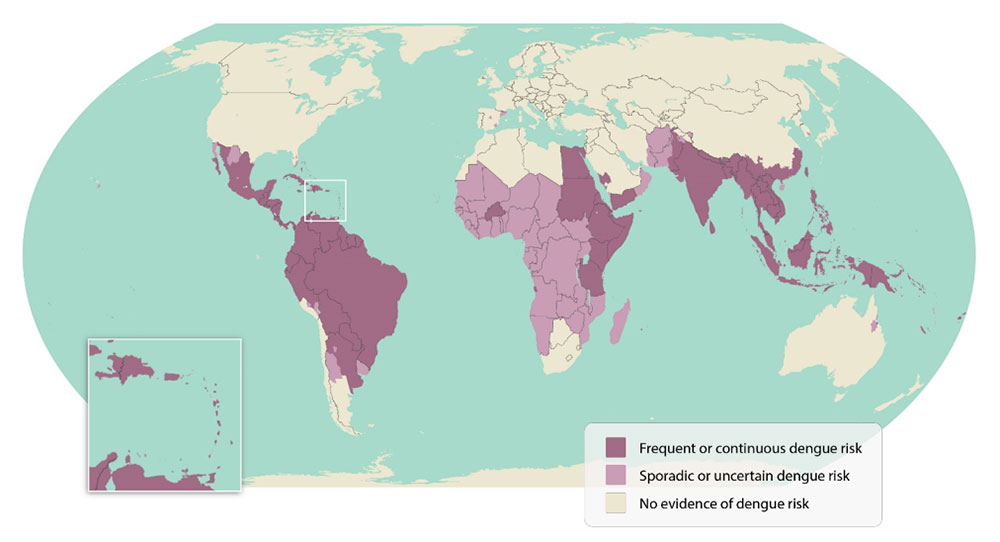
- Mappa della dengue (Centro per il controllo e la prevenzione delle malattie CDC): https://www.cdc.gov/dengue/images/areaswithrisk/Dengue-World-Map.jpg
- Zanzara tigre, SwissTPH
- www.tiger-platform.eu
- L'mpox è una malattia virale che in genere provoca eruzione cutanea, ingrossamento dei linfonodi e febbre.
- Una variante emergente si sta diffondendo rapidamente nella R.D. Congo orientale e nei Paesi vicini, tanto da indurre l'OMS a dichiarare un'emergenza sanitaria di portata internazionale (PHEIC) nell'agosto 2024.
- Il contatto fisico stretto (sessuale o non sessuale) è la principale modalità di trasmissione.
- La malattia ha generalmente un decorso lieve. I bambini, le donne in gravidanza e le persone con un sistema immunitario debole sono i soggetti più a rischio di complicazioni.
- Assicuratevi di prendere le precauzioni generali (vedi factsheet) per prevenire la malattia.
- La vaccinazione contro l'mpox è disponibile, ma attualmente è limitata ai gruppi ad alto rischio di esposizione.
- L'Mpox è una malattia virale che in genere provoca eruzione cutanea, ingrossamento dei linfonodi e febbre.
- Una variante emergente si sta diffondendo rapidamente nella D.R. Congo orientale e nei Paesi limitrofi, tanto da indurre l'OMS a dichiarare un'emergenza sanitaria di portata internazionale (PHEIC).
- Il contatto fisico stretto (sessuale o non sessuale) è la principale modalità di trasmissione.
- La malattia di solito si risolve da sola, ma alcune persone possono sviluppare una malattia più grave e talvolta fatale. I bambini, le donne in gravidanza e le persone con un sistema immunitario debole sono i soggetti più a rischio di complicazioni.
- La vaccinazione contro l'mpox è disponibile, ma limitata ai gruppi ad alto rischio di esposizione.
Il vaiolo è stato riscontrato comunemente in Africa occidentale e centrale per molti anni, dove il presunto serbatoio - i piccoli mammiferi - è endemico. Esistono due tipi di virus del vaiolo delle scimmie, chiamati "cladi", che causano la malattia: il clade I in Africa centrale e il clade II in Africa occidentale. Dalla fine delle campagne di vaccinazione contro il vaiolo all'inizio degli anni '80, i casi di vaiolo sono aumentati, all'inizio lentamente e negli ultimi 5-10 anni in modo significativo, soprattutto nella Repubblica Democratica del Congo (RDC).
Nel 2022, una nuova sottoclade emergente del clade II è stata responsabile di un'epidemia globale che si è diffusa principalmente attraverso il contatto sessuale tra uomini che hanno rapporti sessuali con uomini. Ne è scaturita la prima emergenza sanitaria pubblica di interesse internazionale (PHEIC) dichiarata dall'OMS fino al 2023. Sebbene l'epidemia del clade II sia ora sotto controllo, continua a circolare in tutto il mondo.
Nel 2024, la continua diffusione dell'mpox clade I nelle regioni endemiche dell'Africa centrale, in particolare nella RDC, e l'emergere di una nuova sottoclade Ib nell'est della RDC e nei Paesi limitrofi hanno destato preoccupazione a livello globale e hanno spinto l'OMS a dichiarare una PHEIC per la seconda volta in due anni. L'attuale diffusione geografica della variante mpox clade Ib avviene per vie commerciali attraverso il contatto sessuale (ad esempio, le lavoratrici del sesso), seguita dalla trasmissione locale nelle famiglie e in altri ambienti (che sta diventando sempre più importante).
Trasmissione da animale a uomo
L'Mpox può diffondersi dall'animale all'uomo quando questi entra in contatto diretto con un animale infetto (roditori o primati).
Trasmissione da uomo a uomo
Il vaiolo si può diffondere da persona a persona attraverso uno stretto contatto fisico (sessuale e non) con una persona che presenta i sintomi del vaiolo. Le lesioni della pelle e delle mucose, i fluidi corporei e le croste sono particolarmente contagiosi. Una persona può infettarsi anche toccando o maneggiando indumenti, lenzuola, asciugamani o oggetti come utensili/piatti per mangiare che sono stati contaminati dal contatto con una persona con i sintomi. I membri della famiglia, gli assistenti familiari e i partner sessuali di un caso confermato di mpox sono a maggior rischio di infezione, così come gli operatori sanitari che trattano un caso senza un'adeguata protezione personale.
Il periodo di incubazione (tempo che intercorre tra l'infezione e la comparsa dei sintomi) varia da pochi giorni a 3 settimane. La Mpox provoca un'eruzione cutanea che può essere dolorosa, associata a linfonodi ingrossati e febbre. La febbre può iniziare già prima della fase esantematica. Altri sintomi includono dolori muscolari, mal di schiena e affaticamento. L'eruzione cutanea può essere localizzata o generalizzata, con poche o centinaia di lesioni cutanee. Colpisce principalmente il viso, il tronco, i palmi delle mani e le piante dei piedi. Può essere presente anche nelle aree genitali e sulle membrane mucose come la bocca e la gola. I sintomi durano in genere dalle 2 alle 4 settimane e la persona rimane contagiosa fino alla guarigione di tutte le lesioni (una volta cadute le cabine).
Le complicazioni includono infezioni batteriche secondarie, infezioni polmonari e cerebrali e coinvolgimento di altri organi, parto prematuro e altro. I bambini, le donne in gravidanza e le persone con un sistema immunitario debole sono più a rischio di sviluppare una forma grave di mpox.
La maggior parte delle persone affette da mpox guarisce spontaneamente e non necessita di un trattamento antivirale specifico. La gestione dell'assistenza consiste nell'alleviare il dolore e gli altri sintomi e nel prevenire le complicazioni (ad esempio, la superinfezione). Diversi trattamenti antivirali sono studiati in vari Paesi e possono essere utilizzati in studi o in situazioni cliniche secondo le raccomandazioni delle società mediche nazionali.
In caso di sintomi:
- Rivolgersi immediatamente a un medico
- Se vi è stata diagnosticata la sclerosi multipla:
- Rimanete a casa (isolati) finché l'eruzione cutanea non sarà guarita e non si sarà formato un nuovo strato di pelle. Stare lontano da altre persone e non condividere con altri gli oggetti che si sono toccati aiuta a prevenire la diffusione del vaiolo. Le persone affette da vaiolo devono pulire e disinfettare regolarmente gli spazi che utilizzano per limitare la contaminazione domestica.
- ü Lavarsi spesso le mani con acqua e sapone o con un disinfettante per mani a base di alcol contenente almeno il 60% di alcol.
- ü Non si devono avere rapporti sessuali quando si è sintomatici e quando si hanno lesioni o sintomi. Usare il preservativo per 12 settimane dopo l'infezione. Si tratta di una precauzione per ridurre il rischio di diffusione del virus al partner.
- ü Per ulteriori informazioni su cosa fare in caso di malattia, consultare il LINK del CDC.
Precauzioni generali:
- In tutto il mondo:
- evitare il contatto ravvicinato, pelle a pelle, con persone che hanno o potrebbero avere il virus dell'influenza aviaria o con persone che presentano un'eruzione cutanea (ad esempio, brufoli, vesciche, croste).
- Lavarsi spesso le mani con acqua e sapone o con un disinfettante per mani a base di alcol contenente almeno il 60% di alcol.
- Evitare di toccare oggetti personali potenzialmente contaminati come tazze, lenzuola/vestiti, asciugamani o di condividere utensili/tazze, cibo o bevande con una persona che ha o potrebbe avere il virus del vaiolo.
- Evitare i rapporti sessuali con persone malate; usare il preservativo per un massimo di 12 settimane se il partner sessuale ha avuto il virus del vaiolo.
- Seguire i consigli delle autorità locali.
- Quando si viaggia in aree endemiche/epidemiche in Africa, oltre alle precauzioni generali sopra menzionate:
- Evitare il contatto con gli animali nelle aree in cui il vaiolo si manifesta regolarmente.
- Evitare di mangiare o preparare carne di animali selvatici (bushmeat) o di utilizzare prodotti (creme, lozioni, polveri) derivati da animali selvatici.
Vaccinazione:
Esistono diversi vaccini contro il vaiolo (ad esempio Jynneos®, produzione Bavarian Nordic). Il vaccino Bavarian Nordic è stato originariamente sviluppato per combattere il vaiolo, ma offre una protezione incrociata contro il vaiolo. In Svizzera, il vaccino Jynneos® è autorizzato da Swissmedic dal 2024. I gruppi a rischio (ad esempio, gli uomini che hanno rapporti sessuali con altri uomini o le persone transgender con più partner sessuali) possono essere vaccinati dal 2022 e questa raccomandazione rimane invariata (vedi raccomandazioni dell'UFSP). Alla luce della situazione epidemiologica in Africa nel 2024, il Comitato svizzero di esperti in medicina dei viaggi raccomanda la vaccinazione contro l'mpox per i professionisti che sono/saranno in contatto con pazienti sospetti di mpox in regioni endemiche/epidemiche o che lavorano in un laboratorio in cui è presente il virus (per gli aggiornamenti, vedi news).
Il rischio per la popolazione generale e per i viaggiatori (turisti) è considerato estremamente basso se vengono seguite le precauzioni generali di cui sopra e se la vaccinazione non è raccomandata.
- Rivolgersi immediatamente a un medico.
- La varicella non è una malattia a trasmissione sessuale in senso stretto; il contatto fisico con una persona che presenta i sintomi della varicella (eruzione cutanea in qualsiasi stadio) è sufficiente per trasmettere la malattia. I preservativi non proteggono dall'infezione da mpox!
- Ufficio federale della sanità pubblica (UFSP)
- Organizzazione Mondiale della Sanità: FAQ DELL'OMS
- Centro europeo per il controllo e la prevenzione delle malattie (ECDC)
- Centro statunitense per il controllo e la prevenzione delle malattie (CDC)
- STIs are a common health problem worldwide and can be managed through safer sex, regular testing and treatment.
- If you have had a risk situation, it is important to consult a health care professional as soon as possible to discuss whether HIV post-exposure prophylaxis (PEP) should be given to prevent contracting HIV.
- After a high-risk situation, you are advised to get tested for STIs even if you have no symptoms.
- STIs are a common health problem worldwide and can be managed through safer sex, regular testing and treatment.
- If you have had a risk situation, it is important to consult a health care professional as soon as possible to discuss whether HIV post-exposure prophylaxis (PEP) should be given to prevent contracting HIV.
- After a high-risk situation, you are advised to get tested for STIs even if you have no symptoms.
Enjoying your sexuality freely and responsibly is part of a healthy life. Knowing how to take care of yourself and others is especially important when you are in new situations – like during travel.
Travelers who engage in casual sex tend to be at higher risk of contracting sexually transmitted infections (STIs), including HIV. Being abroad, while also meeting new people, can involve behaving differently and taking more risks than you would at home. It is important to know that certain practices – such as unprotected sex and/or having multiple new sexual partners – can significantly increase the risk for STIs. Some STIs can cause serious complications in some circumstances and can also be transmitted to additional partners if not diagnosed and treated in time. If you are not sure whether you are at risk, Love Life's 'Risk Check' can help.
- Burning or itching in the genital area
- Painful or frequent urination or pain in the lower abdomen
- Pain or soreness with bowel movements.
- Unusual discharge from the penis, anus or vagina
- Sores, redness, blisters or warts in the mouth/lips or genital area In some cases fever
Important: STIs can also occur without any or only mild symptoms. Even if you are not aware of it, you can infect others. Even if you have no symptoms, you should consult your doctor if you have had unprotected sex with a new partner or multiple partners. This is because early detection and treatment are important to prevent transmission and complications from untreated STIs.
STIs can be diagnosed during a physical exam or by examining urine, a sore, a blister, or a swab from the vagina, penis, throat or anus. Blood tests can help with certain diagnosis (hepatitis A, B and C, HIV and syphilis).
The timing of testing is important, as some infections may not be detectable immediately after exposure (diagnostic window). To rule out an infection, HIV and syphilis should usually be tested at least 6 weeks after the sexual contact. In the case of chlamydia and gonorrhea, testing should be done at least 2 weeks after the contact. This applies only if there are no symptoms.
Take also into consideration that access to reliable testing and treatment may be limited in some destinations.
Before you travel:
- Consider STI screening if you have had recent risk exposure
- Ensure vaccinations are up to date (hepatitis B, HPV and depending on sexual practices hepatitis A and mpox)
- Discuss HIV-PrEP with a healthcare provider if appropriate
During travel:
- Follow Love Life's safer sex rules.
- Carry condoms from reliable sources, as quality or availability may vary in some destinations.
- Remember that oral sex can also lead to transmission of STIs.
- If you have had a high-risk situation, it is important to consult a health care professional as soon as possible to discuss whether HIV post-exposure prophylaxis (PEP) should be given to prevent HIV infection. HIV PEP is most effective when given early i.e. within first hours after exposure (max 48 hours after contact).
- Remember that alcohol or drugs may lead to increased risk behavior.
- Remember that you can infect another person/known partner during sex if you have an untreated STI.
- People with a newly diagnosed STI are encouraged to inform their former sexual partners so that they can also be treated.
- Even without symptoms, screening is recommended after risk exposure.
- If you are experiencing symptoms (see above)
- If you have multiple sexual partners, it’s recommended to do an STI-Check at least once a year.
- If you belong to a demographic group with a higher STI-risk. For example, MSM or sex workers and their clients
- If a sexual partner has been recently diagnosed with an STI
- Returning from travel if you had a high-risk contact
- At the beginning of a new monogamous relationship
- Love Life: www.lovelife.ch
- Sexual Health Switzerland: www.sexuelle-gesundheit.ch
- Hepatitis Switzerland: https://en.hepatitis-schweiz.ch/all-about-hepatitis/what-is-hepatitis
- World Health Organization (WHO). Factsheets. Sexually transmitted infections (STIs). 20.12.2025: www.who.int/news-room/fact-sheets/detail/sexually-transmitted-infections-(stis)
There is a risk of arthropod-borne diseases other than malaria, dengue, chikungunya or zika in sub-/tropical regions, and some areas of Southern Europe. These include the following diseases [and their vectors]:
- in Europe
- Borreliosis, FSME (= tick-borne encephalitis), rickettsiosis [ticks]
- Leishmaniasis [sand flies]
- West-Nile fever [mosquitoes]
- in Africa
- Rickettsiosis, in particular African tick bite fever [ticks]
- Leishmaniasis [sand flies]
- African trypanosomiasis = sleeping sickness [tsetse flies]
- West-Nile fever [mosquitoes]
- in Asia
- Scrub typhus [mites]
- Rickettsiosis [fleas or ticks]
- Leishmaniasis [sand flies]
- West-Nile fever [mosquitoes]
- Crimea-Congo-hemorrhagic fever [ticks]
- in North and Latin America
- Rickettsioses and in particular Rocky Mountain spotted fever [ticks]
- Leishmaniasis and Carrion's disease [sand flies]
- American trypanosomiasis = Chagas disease [triatomine bugs]
- West Nile fever [mosquitoes]
- There are other important travel related health risks such as diarrhoea, road traffic accidents, air pollution and more.
- For more information, see the section "Healthy Travelling".